Sewer Camera ROI: How to Calculate Payback on Your Camera
Sewer camera payback = total equipment cost ÷ monthly contribution, where monthly contribution is what your scopes (and, if you count them, the repairs they lead to) earn after direct costs and a maintenance reserve. With realistic inputs for a small shop, the result is often measured in months, not years. But the only numbers that matter are yours, so here is how to build the calculation.
Job volume, price per scope, costs, upsell rate and reserve in the worked example below are hypothetical inputs chosen to show the math. They are not industry statistics or averages. The two camera prices are published prices as of September 2026. Replace every number with your own.
The formula
Break it into four inputs.
- Equipment cost. Camera system, locator (if not built in), spare batteries, a case, report software. Published figures give you a starting point: InspectorPro, a home-inspector insurer, cites camera systems around $6,000–$7,000 including cables and batteries, and financing lender Crestmont Capital puts sewer camera systems anywhere from about $3,000 to $30,000+ depending on class. As of 2026, check current pricing with your dealer.
- Scopes per month. Your realistic average, not your best month. Home inspectors: inspections per month × the share of clients who add a scope.
- Net per scope. Your price minus direct cost: tech time, fuel, consumables, and wear on the push cable and head.
- Repair upsell. Share of scopes that turn into paid repair work × gross profit per repair job. Plumbers and drain contractors only.
Then:
- Monthly contribution = (scopes × net per scope) + (scopes × upsell rate × gross profit per repair) − maintenance reserve
- Payback in months = equipment cost ÷ monthly contribution
Worked example: two setups side by side
Take a two-truck drain cleaning shop buying its first self-leveling push camera. We’ll run the same hypothetical job volume and scope price against two real equipment price points:
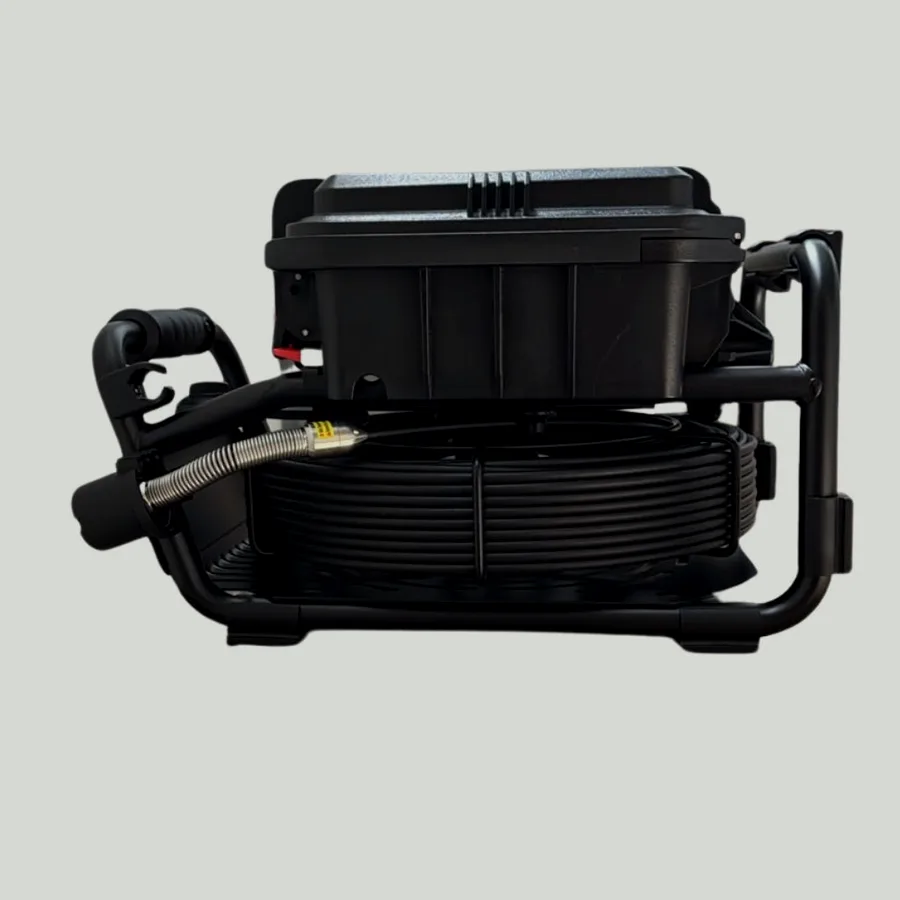
- Setup A: Prokam PRO+ HD, full option, at $2,890. Self-leveling head, 512 Hz sonde, 130 ft push cable. Sold direct by Prokam, with no local dealer network.
- Setup B: a premium dealer-brand kit at about $9,825. As an example, the RIDGID SeeSnake Compact2 65103 kit (self-leveling camera reel with CS6x VERSA monitor, battery and charger) was listed at $9,825.07 by at least one retailer in September 2026. Prices for this kit ranged from about $7,400 to over $13,000 across retailers, so check current pricing.
Disclosure: this site is published by the team behind Prokam. How we handle this.
Both setups get the same $1,000 for a locator and accessories. Check what each kit actually includes before you copy that line. Job volume, price, costs and upsell are hypothetical and identical for both columns, so the only thing that changes is equipment cost.
| Input | Setup A (hypothetical job numbers) | Setup B (hypothetical job numbers) | Where to get your number |
|---|---|---|---|
| Camera system | $2,890 | $9,825 | Dealer or maker quote |
| Locator + accessories | $1,000 | $1,000 | Quote |
| Total equipment cost | $3,890 | $10,825 | Sum |
| Price per scope | $250 | $250 | Your price sheet |
| Direct cost per scope | $90 | $90 | Tech time + fuel + wear |
| Net per scope | $160 | $160 | Price − direct cost |
| Scopes per month | 8 | 8 | Last 3–6 months of invoices |
| Scope contribution / month | $1,280 | $1,280 | 8 × $160 |
| Repair upsell rate | 15% | 15% | Repairs sold ÷ scopes done |
| Gross profit per repair | $800 | $800 | Repair revenue − parts − labor |
| Upsell contribution / month | $960 | $960 | 8 × 15% × $800 |
| Maintenance reserve / month | $75 | $75 | Set aside for cable, head, slip ring repairs |
| Monthly contribution (scopes only) | $1,205 | $1,205 | $1,280 − $75 |
| Monthly contribution (with upsell) | $2,165 | $2,165 | $1,280 + $960 − $75 |
| Payback, scopes only | ≈ 3.2 months | ≈ 9.0 months | Equipment ÷ $1,205 |
| Payback, with upsell | ≈ 1.8 months | ≈ 5.0 months | Equipment ÷ $2,165 |
Now run both setups at different volumes, scopes only (no upsell counted).
Two things stand out. Volume has a big effect on payback: going from 4 to 8 scopes a month cuts it roughly in half, and doubling again halves it again. And at low volume, equipment cost dominates: at 4 scopes a month, the $10,825 kit takes well over a year and a half to pay back on scopes alone, the $3,890 setup under seven months.
Payback isn’t the only thing that separates the two. A dealer brand usually comes with a local service center and loaner options, which matters when a camera down means scopes lost. A direct-sold camera has no local dealer, so ask how repairs, shipping times and warranty claims work before you buy. Cable length, head size and monitor features differ too; match them to the lines you scope.
The home inspector version
Inspectors usually don’t sell repairs, and many deliberately avoid it to stay independent. That removes the upsell line and puts all the weight on attach rate: the share of your home inspection clients who add a sewer scope.
- Scopes per month = inspections per month × attach rate
- Monthly contribution = scopes × net per scope − maintenance reserve
Say, hypothetically, you do 30 inspections a month and 25% of clients add a scope. That’s 7.5 scopes a month. At $160 net per scope and a $75 reserve, contribution is about $1,125 a month: Setup A ($3,890) pays back in about 3.5 months, Setup B ($10,825) in about 9.6 months. The lever here is the attach rate: how you offer the scope at booking (as a line item the buyer’s agent sees, or a checkbox nobody reads) moves it more than the price does. For equipment picks aimed at this workflow, see our guide to the best sewer scope camera for home inspectors.
Don’t forget the insurance side: InspectorPro notes that many home inspection policies exclude sewer scopes unless you add an endorsement, which it puts at roughly $150 a year. Add that to your monthly reserve.
The inputs people get wrong
Direct cost per scope
The easy mistake is to count only fuel. A scope takes tech time: driving, setup, the push itself, reviewing footage with the customer, writing the report. If a tech costs you $45/hr loaded (wage, payroll taxes, benefits), a 1.5-hour scope costs about $68 in labor before fuel. That’s why the example uses $90.
Scopes per month
Use invoices, not memory. Count only scopes you billed. A look after cabling that you didn’t charge for doesn’t count toward scope contribution; it may count toward upsell, if it led to a repair.
Upsell rate
This is the number shops most want to inflate. Track it honestly for three months: scopes performed, repair quotes given, repairs sold. A scope showing a heavy root intrusion or a belly holding water has a very different close rate than a clean line.
Maintenance reserve
Push cables get kinked, heads get cracked, slip rings wear, batteries age. Nobody publishes a reliable “annual repair cost” for sewer cameras, so estimate it from your dealer’s repair price list and set aside a fixed amount each month. It keeps a $1,500 repair from turning a profitable year into a bad quarter.
Price per scope: the lever you control
Volume moves payback the most, but you can’t always add volume. Price you can change tomorrow. In the example, raising the scope price from $250 to $300 lifts net per scope from $160 to $210, and scope-only payback at 8 scopes a month drops from about 3.2 to 2.4 months for Setup A, and from about 9.0 to 6.7 months for Setup B.
Before you raise prices, see what’s typical in your area. Our guide on how much to charge for a sewer camera inspection covers published market ranges, add-ons and a pricing worksheet.
When the ROI doesn’t work
Run the numbers before you buy. If payback on scopes alone runs longer than the camera’s useful life, one of these is usually true:
- You scope too rarely. A couple of scopes a month doesn’t justify a $7,000+ system. Renting for those jobs is often cheaper. Compare the options in buy vs rent vs finance a sewer camera.
- You underprice. Scopes thrown in for free after every clearing produce no scope contribution. If the camera is a sales tool, measure it on upsell alone and be honest about that.
- You bought more camera than your work needs. A crawler or a 400 ft reel for 4” residential laterals is capital sitting in the truck. Match the system to the pipes you actually scope.
A simple ROI checklist
- Get a written dealer quote for the full system, including locator and software.
- Pull 3–6 months of invoices and count billed scopes.
- Calculate direct cost per scope with real tech time.
- Track upsell for at least 3 months before counting it.
- Set a monthly maintenance reserve.
- Calculate payback twice: scopes only and with upsell.
- If financing, add total interest to equipment cost and check that the monthly contribution covers the payment.
Beyond payback
Payback tells you when you get the money back. It doesn’t show everything the camera does for a shop:
- Fewer callbacks. Scoping after clearing shows whether you actually fixed the problem, or just punched a hole through roots that will close again.
- Better quotes. A recorded video with footage marks and a located defect lets you quote a spot repair instead of guessing at a full replacement, and lets the customer see why.
- Referral work. Realtors and home inspectors refer scopes to shops that deliver clean video and a clear report quickly.
None of these fit neatly into a formula, so leave them out of the payback math and treat them as upside. If the numbers work without them, the purchase is solid.
FAQ
What's a good payback period for a sewer camera?
There's no industry benchmark we can point to. As a rule of thumb, if your own numbers show payback inside the camera's warranty period, the purchase carries little risk. If payback runs past two years, look at renting or a cheaper camera first.
Should I count repair work in the camera's ROI?
Count it separately. Show payback from scopes alone and payback with repair upsell. If the camera only pays off with repairs, your scope pricing may be too low, or you're really buying the camera as a sales tool, which is fine if you know it.
Does financing change the ROI?
It changes cash flow, not whether the camera earns money. Add the interest to the equipment cost for the payback math, and compare the monthly payment to your monthly contribution. If the contribution covers the payment from month one, financing is low risk.
How do home inspectors calculate ROI differently from plumbers?
Inspectors usually have no repair upsell, so the math rests on scope price and attach rate: how many of your home inspections add a sewer scope. Multiply inspections per month by attach rate to get scopes per month.