Best Sewer Camera for Plumbers: Picks by Budget and Use Case
There is no single best sewer camera for plumbers. There is a best camera for the lines you scope most, the number of jobs you run a week, and how much downtime you can live with. For most residential shops, that means a self-leveling head of about 1” to 1.3”, 100–200 ft of push rod, a 512 Hz sonde and a way to record and send video.
Below, the options are grouped by price tier, with specs taken from manufacturer and retailer pages as of September 2026. Prices move a lot: check current pricing before you buy.
What a plumber’s camera has to do
Before comparing brands, pin down the job:
- Line size. Most service work happens in 3”–6” building sewers and laterals. Kitchen and lav lines at 1.5”–2” need a smaller head and a more flexible rod.
- Distance. A typical house-to-main run fits inside 100 ft. Long setbacks and rural laterals need 200 ft or more.
- Locating. A 512 Hz sonde in or behind the head lets you mark the defect on the surface before anyone digs. See how the sonde and locator work together.
- Recording. If you sell repairs off the footage, you need clean recording, a footage counter on screen and an easy way to get the file to the customer.
The full spec-by-spec breakdown is in how to choose a sewer camera.
The three price tiers at a glance
| Tier | Typical price (2026) | Who it fits | Examples |
|---|---|---|---|
| Budget | Under $1,500 | Occasional scopes, second rig for a van, spot checks after clearing | Vevor, Sanyipace, Teslong and other import brands |
| Mid | $2,000–4,000 | Shops scoping weekly that want pro features without name-brand pricing | Higher-end import kits, smaller direct-sale brands, used name-brand reels |
| Premium | $5,000+ | Daily scopes, fleet use, dealer service, resale value | RIDGID SeeSnake, Milwaukee M18, General Gen-Eye, Spartan, Vivax vCam |
Budget tier: under $1,500
Import brands have closed the spec gap fast. A Vevor 230 ft kit listed at $850.90 on FactoryPure advertises a 0.9” (23 mm) self-leveling head, a 5 mm push cable, a 9” 1080P screen, a built-in 512 Hz transmitter (locator sold separately), SD-card recording and a 4,500 mAh battery rated for 6–8 hours.
Sanyipace, Teslong and a long list of Amazon brands sell similar packages. Sanyipace’s S830ASMKT, for instance, starts at $1,849.99 for the 165 ft version on the brand’s own site, with a 31 mm self-leveling head, a 9 mm push cable, a 9” screen and a built-in 512 Hz sonde, with optional locators. That puts it just above this tier.
What to check before you buy at this price:
- Push rod stiffness. A 5 mm cable is easy to coil but loses push force in long runs and through multiple bends. A 9 mm rod pushes further.
- Repairs. Ask where the reel goes when the head floods or the slip ring fails, and how long it takes. With many import brands, the answer is “send it overseas” or “buy a new head.”
- Locator. A sonde is only useful with a receiver tuned to the same frequency. Budget kits often list it as an add-on.
Budget cameras make sense as a first camera for a small shop, or as a second rig so the good camera doesn’t ride on every drain call.
Mid tier: $2,000–4,000
This is the thinnest part of the US market. Most name-brand reels start near $5,000, so the mid tier is filled by upper-end import kits (longer reels plus a locator), used or refurbished name-brand systems, and a few smaller brands.
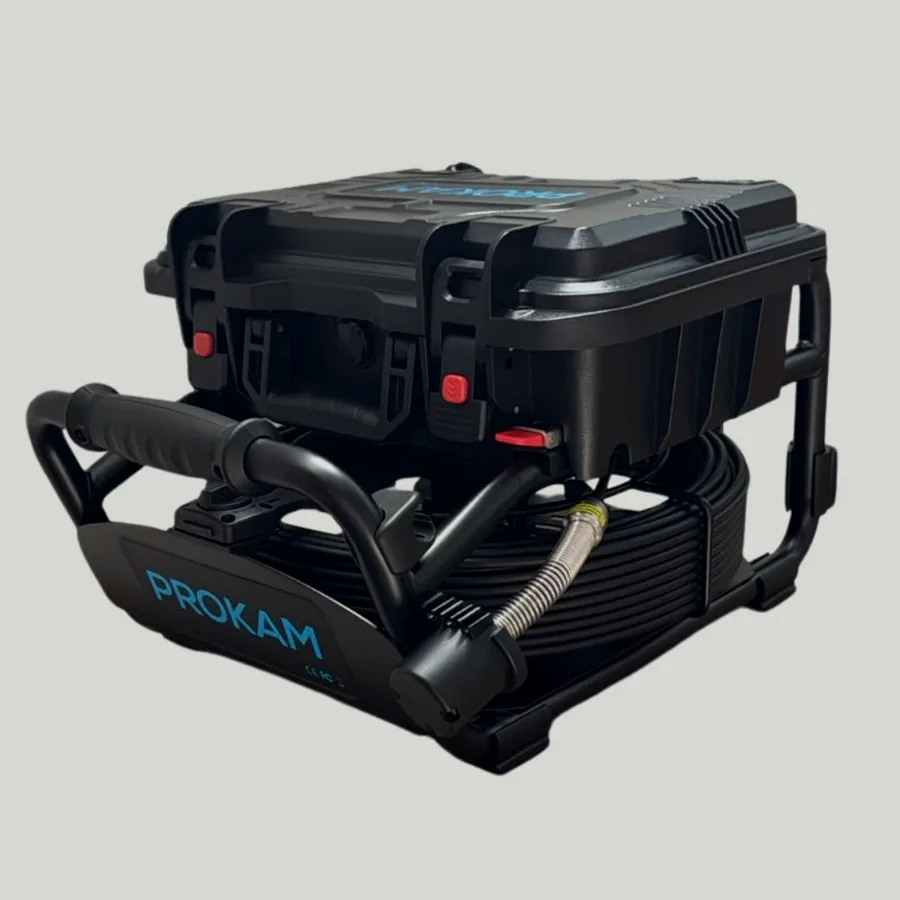
One of them is the Prokam PRO+ HD.
Disclosure: this site is published by the team behind Prokam. How we handle this.
It comes as a single full-option package: a 23 mm self-leveling Full HD head, a built-in 512 Hz sonde, 130 ft of reinforced 6.8 mm push rod, a 10” screen, an on-screen distance counter and photo and video capture for customer reports, listed at $2,890 as of 2026. The manufacturer lists a pipe range of about 1.5” to 8”, with 90° elbows passable from 2.4” (60 mm). It is sold direct by Prokam, without a local dealer network, so factor in how repairs and parts are handled before you compare it with a dealer-supported reel. It is not built for 200 ft runs.
For a used name-brand reel, have the seller show a live picture, a working sonde and the counter, and budget for a new push cable if the jacket is worn through.
Premium tier: $5,000 and up
This is where dealer service networks, parts availability and resale value come in. All the systems below come from established brands; the specs come from manufacturer or retailer pages.
| System | Head | Push rod | Line range | Locating | Listed price seen |
|---|---|---|---|---|---|
| RIDGID SeeSnake Compact2 | 25 mm self-leveling | 100 ft, 0.26” | 1.5”–6” | 512 Hz sonde | ≈ $10,600 with CS6x VERSA monitor |
| RIDGID SeeSnake microReel L100 | Small head | 100 ft, 0.27” | 1.5”–4” | 512 Hz sonde in head | ≈ $4,700 with micro CA-350 |
| Milwaukee M18 2973-22 | 25 mm 1080p self-leveling | 120 ft, mid-stiff | 2”–6” | Pair with M12 locator | $8,685 (SupplyStop) |
| Milwaukee M18 2974-22 | 34 mm 1080p self-leveling | 200 ft, 12 mm stiff | 3”–10” | Pair with M12 locator | ≈ $9,400 |
| General Gen-Eye POD Wi-Fi (SL-GPW-E) | 1.625” self-leveling | 200 ft, 0.475” Gel-Rod | 3”–10” | 512 Hz sonde | $6,463 sale / $7,604 list |
| Spartan Traveler Lite | 23 mm self-leveling | 130 ft, 6 mm | 2”–4” | 512 Hz | $4,999 |
| Vivax-Metrotech vCam-6 | 34 or 46 mm 1080p self-leveling | 200, 300 or 400 ft | 3”–8” | Multi-frequency sonde | CA$13,460 (Canadian retailer) |
A few notes on how these differ in practice:
- RIDGID SeeSnake. The most common name on service vans. The Compact2 covers 1.5”–6” with a 100 ft rod, and the removable-drum microReel targets 1.5”–4” lines. Monitors (CS6x VERSA and others) are sold separately or in kits, which is why listed prices vary so much.
- Milwaukee M18. Runs on M18 batteries and records to a 500 GB Control Hub that streams to a tablet or phone. The 2973 (120 ft, 25 mm head) is sized for 2”–6” residential work; the 2974 (200 ft, 34 mm head, 12 mm stiff cable) for 3”–10” lines. Milwaukee sells an M12 locator separately and in bundles.
- General Pipe Cleaners Gen-Eye. The POD Wi-Fi pairs a 7” monitor with Wi-Fi to phones and tablets. The X-Pod Plus kit (SL-GXP-F), listed at $9,559 on sale, adds the GL-100 Hot Spot locator and USB recording with voice-over.
- Spartan Tool. The Traveler Lite uses your own iOS or Android tablet as the screen through the Spartan Vision app, which includes a PDF report builder. The SparVision 200 is the 200 ft version, also with a self-leveling head and a 512 Hz beacon.
- Vivax-Metrotech vCam-6. Longer reels (up to 400 ft), a 1 TB internal drive, a 9.7” screen and a Wi-Fi app. It sits closer to municipal and commercial work than to a one-van residential shop.
Picks by use case
| Your main work | What to look for | Where to start |
|---|---|---|
| Drain cleaning, checking after clearing | 100 ft, small self-leveling head, fast setup | Budget import as a second rig, or RIDGID microReel / Spartan Traveler Lite |
| Residential sewer repair and replacement sales | Self-leveling, 512 Hz sonde, clean recording, 100–200 ft | Prokam PRO+ HD, Milwaukee 2973 or 2974, Gen-Eye POD, RIDGID Compact2 |
| Long laterals and light commercial | 200 ft+, stiff 12 mm-class rod, 6”–10” range | Milwaukee 2974, Gen-Eye POD 200 ft, Vivax vCam-6 |
| Small branch lines, 1.5”–2” | Head near 1” or smaller, flexible rod | RIDGID microReel, Gen-Eye mini head, 23 mm heads |
| Tight budget, low to medium volume | Sonde, counter, recording, and a plan for repairs | Vevor, Sanyipace, Prokam PRO+ HD |
If you are weighing whether to buy at all, the numbers are in sewer camera ROI.
How to decide
- Count your scopes. Under two a week, a budget or mid-tier camera will likely pay for itself long before it wears out. Daily scopes justify premium gear and dealer service.
- Match the head to your smallest common line, and the rod to your longest common run.
- Do not skip the locator. A camera without a way to mark the spot on the surface limits the jobs you can sell.
- Ask the dealer about repair turnaround and loaner units. A camera in the shop for three weeks costs more than the price gap between tiers.
FAQ
What is the best sewer camera for a plumber just starting out?
One that covers 3"–6" laterals with at least 100 ft of push rod, a 512 Hz sonde and a footage counter. Whether that is a budget import or a name-brand reel depends on how many scopes a week you expect and how much downtime you can accept when it needs repair.
Are cheap Amazon sewer cameras good enough for professional work?
For occasional use, many are. The spec sheets now list self-leveling heads, 512 Hz sondes and 200+ ft cables. What you give up is usually push rod stiffness, the local repair network and the resale value, not the picture on day one.
Do I need a self-leveling camera head?
If customers or inspectors watch the footage, yes. An upright picture makes bellies and clock positions readable. For quick checks on small branch lines, a fixed head is fine.
How long should the push rod be for residential work?
100 ft covers most house-to-property-line runs. If you regularly scope to a city main set back from the street, or through long rural laterals, look at 200 ft.